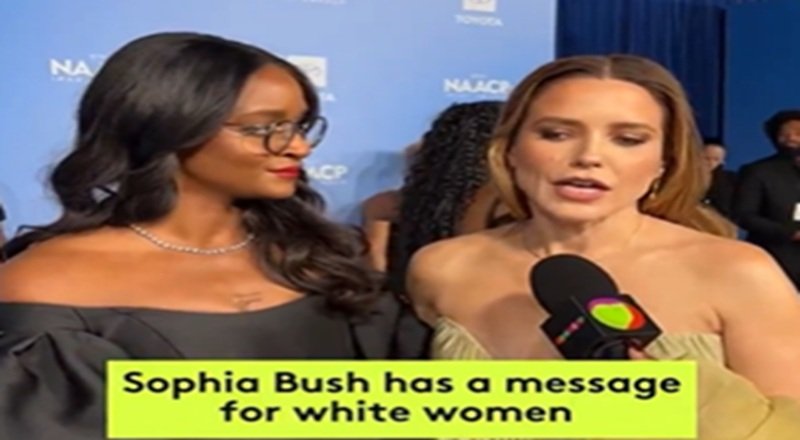
At the 57th NAACP Image Awards, Sophia Bush used her platform to urge white Americans to support Black and brown communities with the same enthusiasm they bring to consuming Black culture—an unscripted call that quickly resonated across social media.
There are moments on a red carpet when the lights, gowns, and posing fade into the background, and something more essential rises to the surface. Such a moment unfolded at the 57th NAACP Image Awards, where actress and activist Sophia Bush, standing beside her friend and business partner Nia Batts, offered a candid, urgent plea captured in a now-viral clip. Speaking as “the white friend at this event,” Bush called on white women and men to recognize the cultural debt owed to Black America—and to match their love for Black culture with meaningful political and social action.
Her tone was steady, intimate, and unvarnished. It was clear this was not a prepared speech but the kind of truth that sits close to the heart. Dressed in an elegant gown, she faced the camera and spoke plainly: “So much of what we love in America comes from Black culture. And white people need to show up for Black people the way they show up to be entertained by Black culture.” The statement, delivered on a night dedicated to celebrating Black excellence, was both a reflection of the moment and a challenge shaped by the broader tensions defining the American landscape in 2026.
A Message Grounded in Accountability and Respect
Bush’s choice to address white audiences directly was striking. By framing her remarks through the lens of responsibility rather than performance, she avoided the common pitfall of centering herself in a space designed to honor Black creatives. Instead, she positioned herself as someone speaking to her own community—a gesture that felt aligned with the ethos of true allyship.
The NAACP Image Awards, held at the Pasadena Civic Auditorium, are a space where Black film, television, literature, and music are celebrated with reverence. Bush understood the gravity of speaking there. Her words acknowledged both the roots of American popular culture and the structural realities that continue to shape Black and brown lives. “Given who’s in office,” she added, “and given what we’re seeing happening to Black and brown communities in our country, we better get our shit together.” It was a blunt but necessary reminder that politics and culture are inseparable, especially in a moment marked by escalating rollbacks to diversity initiatives, civil rights protections, and social-justice efforts.
Her closing line—sharp, unscripted, and delivered without apology—became the spine of the conversation that would ricochet across X, Instagram Reels, and TikTok. The clip, shared with the caption “Say that Sophia!!,” quickly earned more than 1,200 likes and thousands of additional engagements, with users praising her for saying what many had long felt but rarely heard voiced so directly by a white public figure.
A Record of Advocacy That Gives Her Words Weight
Part of the clip’s resonance comes from the fact that Bush has long operated at the intersection of artistry and activism. Her public record includes campaigning for reproductive rights, joining then–Vice President Kamala Harris on voter-engagement tours, advocating for LGBTQ+ protections, and supporting racial justice movements. She is not new to this work, and for many viewers, the red-carpet comment felt like an extension of a consistent, values-driven approach rather than a one-off moment.
Her presence at the awards alongside Nia Batts—her close friend and co-founder of Union Heritage, a venture focused on wellness and heritage spaces—underscored her connection to Black women beyond rhetoric. Their partnership, grounded in empowerment and investment, lent the moment a sense of lived commitment rather than symbolic performance.
In this light, Bush’s words carried an intimacy: not a reprimand, but an invitation to reflection. She spoke with the seriousness of someone who understood the stakes—not only politically, but culturally. Her statement aligned with research indicating that while white Americans engage with Black cultural production at high rates, measurable support for policies that advance racial equity lags behind. The disconnect is real, and Bush’s comment distilled it into a single, memorable call to action.
A Cultural Conversation Sparked by 28 Seconds of Truth
Short, unscripted clips often go viral because they are sharp or entertaining. This one did so because it was honest. Within hours, comments poured in: “This is allyship,” “She said that,” “Sophia always shows up,” and “This is how you use your platform.” Many noted her consistency, contrasting her clarity with the vague platitudes often offered in Hollywood.
Others situated the comment alongside broader political anxiety. With a presidential administration critics deem hostile to civil rights protections, Bush’s urgency felt timely. Rather than allowing the Image Awards to exist as a siloed celebration, she mobilized the moment—reminding viewers that joy and justice, celebration and struggle, exist in constant relationship.
Yet not all reactions were uniformly positive. Some viewers felt she was centering her whiteness at a Black celebration. Others criticized her for referencing political dynamics, calling the statement divisive. But even these critiques underscored the very tension Bush was addressing: the discomfort some white audiences feel when asked to extend their admiration for Black culture into action that requires accountability or sacrifice.
What It Means When a White Woman Speaks Up in Black Spaces
Bush’s remarks did not attempt to overshadow the awards themselves. Instead, they acknowledged the lineage of Black cultural creation that sustains vast segments of American entertainment. Her presence as a guest ally—an invited participant rather than a featured honoree—was significant. She took on the responsibility of speaking directly to other white viewers so that the burden of explanation did not fall once again on Black women, who often carry the emotional labor of articulating the inequities they face.
And in that sense, the clip became more than a red-carpet soundbite. It transformed into a cultural artifact of its own—one that captured a white woman using visibility not to soften truth, but to amplify it.
A Call to Show Up With More Than Appreciation
Bush’s final line—“we better get our shit together”—wasn’t about profanity. It was about clarity. It was about asking white audiences to interrogate the gap between their enthusiasm for Black creativity and their willingness to support Black lives materially and politically. It was about recognizing that allyship is not sentimental; it is structural.
In that brief moment, she distilled a central truth: that the whole of American popular culture rests on Black innovation, yet Black communities continue to bear the weight of inequities that entertainment alone cannot repair. Showing up, as she framed it, means closing the distance between admiration and action.
It was not a speech crafted for applause. It was a call made in real time, at an event designed to honor the very communities she referenced. And perhaps that is why it resonated—because it arrived without fanfare, offered with the steadiness of a woman who understands that allyship is not about centering oneself, but about stepping forward when silence would be easier.