
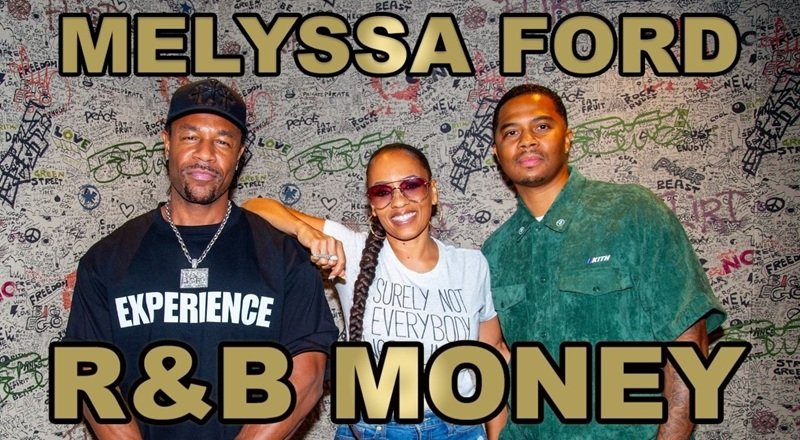
The Bookworm Behind the Bikini: Melyssa Ford Tells Her Whole Story on R&B Money
Ask anyone who grew up with a TV tuned to BET and they can describe the scene: a sunlit pool, a bikini, and one dive that turned Jadakiss’s “Knock Yourself Out” into a cultural landmark. The woman in that frame was Melyssa Ford, and for a stretch of the late ’90s and early 2000s, she was the most requested face in hip-hop and R&B videos.
On a recent episode of the R&B Money Podcast, Ford sat with Tank and J. Valentine for more than two hours. What came out wasn’t a nostalgia tour. It was the story of a woman who kept her mind intact while the world tried to reduce her to her body.
The Nerd Before the Vixen
Long before call sheets, little Melyssa was reading novels by six and skipping playdates for books. Raised by a Bajan father and a white mother, both immigrants, she grew up between two soundtracks: Barry White and Parliament in her dad’s baby-blue Pontiac, Fleetwood Mac and the Doobie Brothers riding shotgun with her mom.
She studied forensics and idolized John Douglas, the FBI profiler behind its behavioral science unit. Entertainment wasn’t the plan. It was, in her words, “happenstance.”
That matters, because the world spent years assuming the pretty girl in the video had nothing going on upstairs. Spoiler: she was the friend everyone called to decode a confusing movie.
Discovered by Little X, Protected by Her Crew
Her break came when Little X (now Director X) wanted the perfect girl for a Canadian rap video and rejected everyone until he saw her photo. He became her champion, flying her to New York for “Tommy’s Theme” from the Belly soundtrack. Days later, Hype Williams’ team booked her for 112’s “Anywhere,” and the run was on: Jay-Z’s “Big Pimpin’” shot during Carnival in Trinidad, then Ghostface Killah’s “Cherchez LaGhost.”
What hit hardest was how she and her fellow Canadian models looked out for each other. Seeing familiar names on the call sheet meant two things: a good time and safety. “There was no MeToo back then,” she reminded us, describing sets that could turn into shark-infested waters.
Black women building their own safety nets before the industry even had language for it? Say that.
The Power of No (and the $10K Day)
Plot twist: Melyssa’s priorities were school and her three jobs, so she kept turning down videos, including a shoot in Tahiti. That scarcity drove her rate up. By “Knock Yourself Out,” a concept built around one woman instead of a pool full of extras, she was making $10,000 a day.
And yet she admits she was deeply insecure about her thick thighs and curves, the very body that helped rewrite mainstream beauty standards. Looking back, she wishes she could tell her 21-year-old self she was “the embodiment of life.” If that doesn’t speak to every woman who’s ever fought with her mirror, nothing will.
Jessica Rabbit Had a Byline
The “Jessica Rabbit” nickname came from a partygoer at Justin’s, Diddy’s restaurant, where Melyssa waitressed after moving to the States. She leaned into the persona as a boundary: when cameras rolled, she was the fantasy; when they stopped, it was sweatpants and a bare face.
When Smooth magazine wanted her to model for its sex column, she asked to write it, too. Editors wanted her to dumb it down. Her response? Maybe readers should rise to the occasion. Iconic.
The Capital-P Pivot
Knowing when to take the “exit ramp,” she started pitching herself to BET around 2003, paying her own way to Daytona and bringing her own makeup artist to prove she was serious. By 2004 she was one of the network’s faces. In 2007 she moved to Sirius radio so audiences would focus on her voice, not her body.
She studied the greats like a syllabus, from Angie Martinez to Oprah to Barbara Walters. By 2016 she was co-hosting Hollywood Unlocked Uncensored before launching her own show, I’m Here for the Food.
Grief, Perimenopause, and Choosing Joy
Then life cracked open. Her mother was diagnosed with cancer, the pandemic hit, and her mom passed in 2020. Melyssa paused everything to grieve as loss and perimenopause collided.
She came back in November 2024 with a reborn show centered on women’s sexual health, mental health, and something she proudly calls being a “pro-aging advocate.” Nearly 50, single and child-free, she calls talking openly about that life revolutionary. Society tells women to fight aging with every breath. Melyssa is sinking into what she called “the bath of unapologeticness.”
She’s also writing a book about the days she spent at her mother’s bedside and planning retreats, including ones for men.
Beauty Was the Door, Not the Destination
Plenty of people in that era called videos a stepping stone. Ford actually used them that way, and she kept her integrity, her boundaries, and her voice the whole way through. Younger women now stop her to say watching that journey shaped how they move.
Near the end of the episode, she thanked one of the hosts for carrying her through a 2007 Las Vegas appearance on the day she learned of her mother’s first cancer diagnosis. Tenderness like that rarely makes it into stories about this era.
Black women, she said, know how to pivot with a capital P. Melyssa Ford has spent more than two decades proving it.



Leave a Reply