

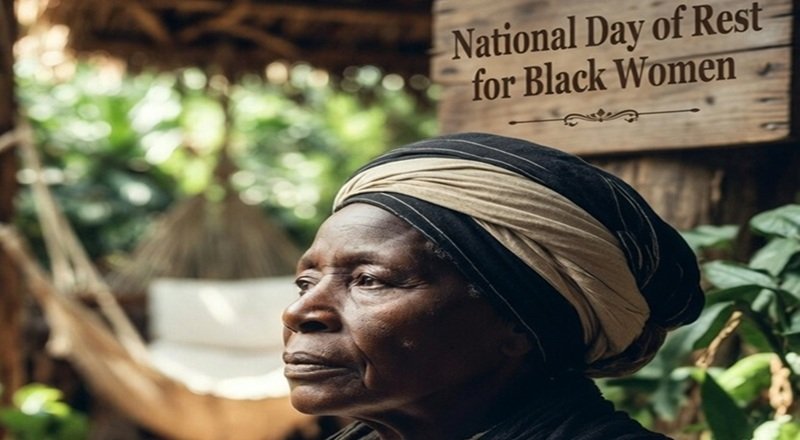
On March 10, a day grounded in Harriet Tubman’s legacy invites Black women to pause, reclaim their breath, and recognize rest not as luxury, but as liberation.
Rest has always moved through Black women’s lives like a fragile inheritance — cherished when possible, postponed when demanded, reclaimed only when the world loosened its grip. On March 10, that inheritance is honored with intention. The National Day of Rest for Black Women arrives not as a holiday or a hashtag, but as a gentle assertion of worth. It asks Black women to step back from the pace of their responsibilities and reintroduce themselves to their own stillness. It offers permission in a world that is far too comfortable benefiting from their exhaustion.
The date is not incidental. March 10 marks the anniversary of Harriet Tubman’s passing — a woman whose courage reshaped the spiritual and political landscape of this country, and whose legacy has long been framed through relentless motion: the miles she walked, the people she guided, the paths she carved. But this observance reframes her memory with a quieter kind of reverence. If Tubman ran so others could be free, then part of that freedom must include the ability to stop moving. Rest becomes an inheritance just as powerful as resilience.
A Pause Rooted in Ancestral Wisdom
The beauty of this day lies in its simplicity. It does not dictate how rest must look or what it must accomplish. It recognizes that Black women carry histories and responsibilities that rarely leave space for softness, and it encourages them to reclaim the forms of care that are too often deferred. Whether that care looks like a long morning in bed, a slow walk through the neighborhood, a journal open beside a cup of tea, or a moment free of expectation — the act itself becomes restorative.
It also becomes political in the gentlest sense. The idea of rest as resistance is not new; it echoes through the work of thinkers like Tricia Hersey of The Nap Ministry, whose theology of rest insists that grind culture, capitalism, and white supremacy rely on the fatigue of Black communities. But the National Day of Rest for Black Women sharpens the focus. It names who has carried the heaviest toll. It honors the emotional labor, the community caretaking, the cultural leadership, and the generations of unthanked work that have shaped Black womanhood in both private and public life.
An Interruption of Expectation
To rest on March 10 is to interrupt a myth — that Black women are somehow built for endless endurance. That they exist as the steady emotional anchor, the unyielding provider, the voice of reason, the first volunteer. These roles are often inhabited with grace, but grace should not be mistaken for limitlessness.
Rest softens that myth.
It says: I am not inexhaustible;
It says: I am human before I am helpful;
It says: My body is not a resource for others to extract;
And perhaps most beautifully, it says: Rest does not require permission.
The Emotional Geography of March 10
Because the observance sits within the arc of Black History Month and Women’s History Month, it offers a kind of reflective bridge — a chance to consider not just what Black women have contributed, but what they have sacrificed along the way. The day acknowledges the activism that asked Black women to fight, the advocacy that depended on them to speak, and the households that relied on them to hold everything together.
But instead of retelling those narratives, it invites a shift:
from duty to desire,
from perseverance to preservation,
from exhaustion to intentional restoration.
This shift is subtle but meaningful. It reframes survival as something more expansive than endurance. Rest becomes a form of freedom that Harriet Tubman herself was rarely afforded — a freedom contemporary Black women can claim with intention.
A Collective Softening
What makes the National Day of Rest for Black Women feel particularly resonant is its communal spirit. It is not a solitary practice, even though rest itself may be. Across social platforms, in group chats, in wellness circles, and in quiet corners of cities and small towns, Black women remind one another to slow down. They send gentle nudges — log off, say no, choose ease this time. The solidarity in these exchanges is its own form of nourishment.
Rest, in this context, is not passivity. It is a collective softening — a refusal to allow the world to harden Black women in places that were meant to remain tender.
The Path Forward
Even as the day concludes, its intention remains: to invite rest not as an annual ritual but as a sustained practice. The National Day of Rest exists to leave a residue — a lingering awareness that care must be folded into the everyday lives of Black women, not placed on layaway until exhaustion demands it.
The wisdom of the day is simple:
A rested Black woman is a powerful one.
A cared-for Black woman is a visionary one.
A Black woman who grants herself softness reshapes the world around her.
On March 10, the invitation is clear: step away, breathe deeply, and allow rest to become part of the life Harriet Tubman made possible — a freedom built not only through struggle, but through the sacred act of stopping.












Leave a Reply