

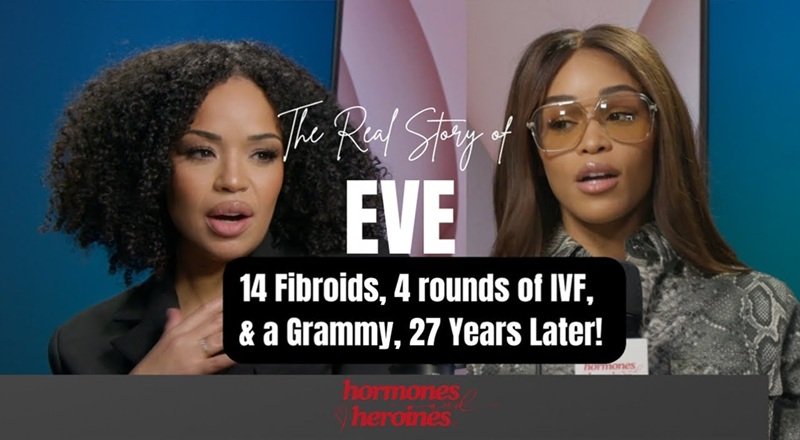
A quiet, powerful conversation about pain, patience, and the kind of resilience that doesn’t always make the highlight reel.
For decades, Eve has existed in a rare space—both deeply familiar and just out of reach. A Grammy-winning artist, actress, and cultural fixture, she has long embodied a certain kind of effortlessness. The kind that suggests clarity, confidence, and control.
But as she sat down for a candid conversation on Hormones & Heroines, a different rhythm emerged. Slower. More intentional. Less about performance and more about truth. What unfolded wasn’t a reinvention, but a revealing—of the private battles that shaped her long before motherhood ever arrived.
Because behind the legacy and longevity was a body quietly asking to be heard. And for years, it wasn’t.
When Pain Becomes Normalized
The story begins where so many similar ones do: with dismissal.
Painful periods, she recalls, had been part of her life since she was a child. Severe enough to disrupt, but not enough—at least in the eyes of doctors—to warrant deeper concern. She was told what many are told: that discomfort is simply part of the experience. Something to endure rather than investigate.
It wasn’t until much later, after years of trying to conceive, that the truth surfaced.
An MRI revealed 14 fibroids—far more than the three she had previously been told existed. The discovery was both validating and unsettling. Proof that something had been wrong all along, and a reminder of how easily women’s pain can be minimized.
“I had to get a myomectomy,” she explained, describing the procedure as comparable to a C-section.
What followed was a moment she still holds onto: her first pain-free period. A quiet milestone, but one that moved her to tears.
The Emotional Weight of Trying
Fertility journeys are rarely linear, and Eve’s was no exception.
Between the physical toll of surgery and the emotional intensity of IVF, the process became an exercise in endurance. Four rounds. Each one carrying its own cycle of hope, anticipation, and uncertainty.
There’s a particular kind of pressure that exists when life continues moving forward while something so personal remains unresolved. Work commitments. Public appearances. Expectations. All unfolding while navigating something deeply private.
“It was hard,” she admitted.
Yet within that difficulty was a quiet insistence on survival. On continuing. On not allowing the weight of the process to become the end of the story.
Support, she noted, made the difference. Whether through trusted relationships or professional guidance, having space to speak openly became essential—not optional.
The Moment Everything Shifted
The fourth round brought something different.
Pregnancy, when it finally arrived, wasn’t just a medical success—it was a recalibration. A moment that pulled her out of the constant negotiation between past disappointment and future fear, and placed her firmly in the present.
There was anxiety, of course. That never fully disappears. But alongside it came something unexpected: calm.
For someone who describes herself as often living “in the clouds,” pregnancy grounded her. It demanded presence. Awareness. A connection to her body that had previously been complicated by pain and uncertainty.
And then, motherhood.
Redefining Identity Through Motherhood
Eve doesn’t hesitate when she names it—motherhood is her favorite role.
Not because it’s easy. In fact, she describes it as everything at once: joyful, chaotic, frustrating, and deeply fulfilling. But there’s a clarity to it that cuts through everything else.
It’s also a space where discovery continues. Watching her son grow has become a mirror, reflecting parts of herself she hadn’t fully explored before.
“I love mothering,” she shared simply.
There’s a softness in that statement, but also strength. A recognition that identity isn’t fixed—it evolves. Expands. Deepens.
The Quiet Power of Letting Go
Not every part of her story comes with resolution.
She spoke candidly about past moments—career missteps, personal struggles, and periods of unhappiness—that shaped her in ways she’s still unpacking. A DUI, in particular, became a forced pause. A moment that interrupted everything and demanded reflection.
“I was unhappy,” she said plainly.
It’s a rare kind of honesty. One that resists the urge to soften or reframe. Instead, it sits in truth, allowing space for understanding rather than judgment.
Sobriety, even temporarily, created clarity. It exposed patterns. Offered perspective. And ultimately became part of a larger process of reclaiming control.
Partnership, Openness, and Choosing Differently
Her personal life, too, reflects a willingness to approach things differently.
Her relationship with her husband—one that crosses cultural and geographic boundaries—wasn’t built on familiarity, but on openness. A decision to move beyond expectations and embrace something that felt aligned at its core.
“It just works,” she said.
There’s something understated about that conclusion. No grand explanation. Just a quiet confidence in what feels right.
And perhaps that’s the throughline in all of it—learning to trust instinct over noise.
A Story That Feels Familiar
While Eve’s journey is uniquely her own, the themes resonate far beyond her experience.
The dismissal of pain. The complexity of fertility. The balance between ambition and personal desire. The process of unlearning what no longer serves.
These are not isolated narratives. They are shared, often silently, by countless women navigating similar paths.
What makes her story powerful isn’t just the outcome—it’s the willingness to speak to the in-between. The uncertainty. The vulnerability. The parts that don’t always make it into public conversation.
The Full Picture
Success has never been the full story.
Not for Eve, and not for anyone. What exists behind it—the effort, the setbacks, the moments of doubt—carries just as much weight. Sometimes more.
What she offers now isn’t just reflection, but permission. To ask questions. To seek second opinions. To demand more—from systems, from others, and from oneself.
Because resilience doesn’t always look like strength in the traditional sense. Sometimes, it looks like rest. Like honesty. Like choosing to try again, even when the outcome is uncertain.
And sometimes, it looks like finally being heard.







Leave a Reply