
With a historic supermax extension, A’ja Wilson’s next chapter reflects not just dominance on the court, but a broader shift in value, visibility, and control.
Some contracts exist as numbers on paper. Others signal a change in how value itself is understood. A’ja Wilson’s newly signed three-year, $5 million supermax extension with the Las Vegas Aces belongs firmly in the latter category.
Announced on April 15, 2026, the deal does more than secure her future with the franchise that drafted her No. 1 overall in 2018. It reframes what it means for a player to be compensated in alignment with her impact. Fully guaranteed and structured to scale with the league’s evolving salary cap, the contract places Wilson at the center of a financial model that is finally beginning to reflect the reality of her influence.
For a player who has spent her entire professional career redefining excellence, the moment feels less like a breakthrough and more like a long-delayed correction.
Loyalty, Reconsidered and Rewarded
Wilson’s decision to remain in Las Vegas carries a significance that extends beyond team continuity. In an era where movement is often framed as leverage, her choice to stay—without testing free agency—introduces a different narrative.
Her previous contracts tell that story quietly. From a rookie deal averaging under $60,000 per year to a team-friendly extension that prioritized roster flexibility, Wilson consistently positioned collective success alongside individual gain. That calculus has now shifted, not in opposition to loyalty, but in recognition of it.
This extension acknowledges what has already been built. It affirms that staying can be strategic, that commitment can carry weight, and that patience, when paired with undeniable performance, can reshape outcomes.
The Architecture of a New Financial Reality
The structure of Wilson’s deal is as notable as its headline number. By tying her earnings to 20 percent of the team’s salary cap each season, the contract introduces a level of fluidity rarely seen in prior WNBA agreements.
This approach reflects the league’s new collective bargaining agreement, where revenue growth directly influences player compensation. As the cap rises, so too does Wilson’s earning potential—creating a model where success is shared rather than fixed.
It is a framework that mirrors broader shifts in how labor and value intersect. Compensation is no longer static. It responds, evolves, and acknowledges the role players have in driving the league forward.
From Undervalued to Unmatched
The timing of this deal carries its own quiet irony. Just one season ago, Wilson was not among the league’s top 25 highest-paid players, despite delivering one of the most dominant campaigns in basketball history.
Her 2025 season—defined by a rare convergence of MVP, Defensive Player of the Year, Finals MVP, and scoring title—should have existed at the pinnacle of compensation. Instead, it highlighted a gap between performance and pay that has long defined women’s sports.
This extension closes that gap decisively. It does not simply elevate Wilson above her peers financially. It establishes a new baseline for what elite performance demands.
Excellence as a Standard, Not an Exception
At 29, Wilson’s résumé already reads as a culmination. Multiple championships, MVP awards, Olympic gold, and statistical dominance have positioned her as one of the most complete players the game has seen.
Yet the tone surrounding this contract does not suggest finality. If anything, it reinforces the idea that excellence, in her case, is not a peak but a standard.
Her public response—brief, confident, and unmistakably her own—captured that energy. There was no need for elaboration. The moment spoke for itself, grounded in a career that has consistently exceeded expectation.
Visibility, Style, and the Business of Being Seen
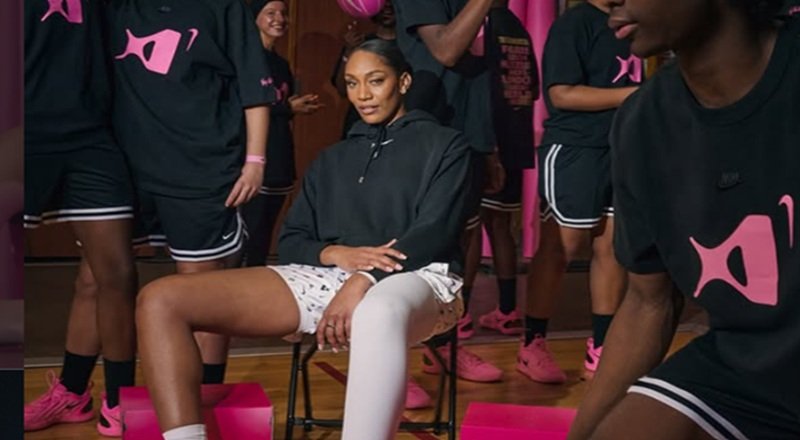
Wilson’s influence has never been confined to the court. Her growing presence across fashion, branding, and endorsement spaces reflects a broader understanding of what it means to build a modern athletic identity.
Her Nike extension, signed in 2024, signaled that trajectory early. This latest contract builds on it, reinforcing her position not only as a player, but as a figure whose visibility carries cultural weight.
In this sense, the deal exists at the intersection of sport and lifestyle. It acknowledges that value is no longer determined solely by statistics, but by presence—how a player moves through spaces, shapes narratives, and expands what visibility looks like.
A League Learning to Meet Its Moment
The WNBA’s new collective bargaining agreement created the conditions for this deal, but the moment itself belongs to the players who made such progress necessary.
Wilson’s contract stands as a reflection of years of advocacy, performance, and persistence across the league. It represents a shift toward equity that, while overdue, feels increasingly inevitable.
There is a clarity in how the numbers align now. They do not inflate her value. They begin to approximate it.
Legacy, Secured in Real Time
Perhaps the most compelling aspect of this extension is how it situates Wilson’s legacy in the present.
There is no waiting for retrospective acknowledgment, no need for post-career validation. The recognition is happening now, in real time, with structures in place to sustain it.
Her decision to remain in Las Vegas ensures continuity, but it also allows her to shape the next phase of her career on her own terms. Championships may follow. Records may fall. But the foundation has already been set.
In many ways, this deal is less about what comes next and more about what has already been proven.
A’ja Wilson has long been one of one. Now, the numbers finally reflect it.










Leave a Reply