

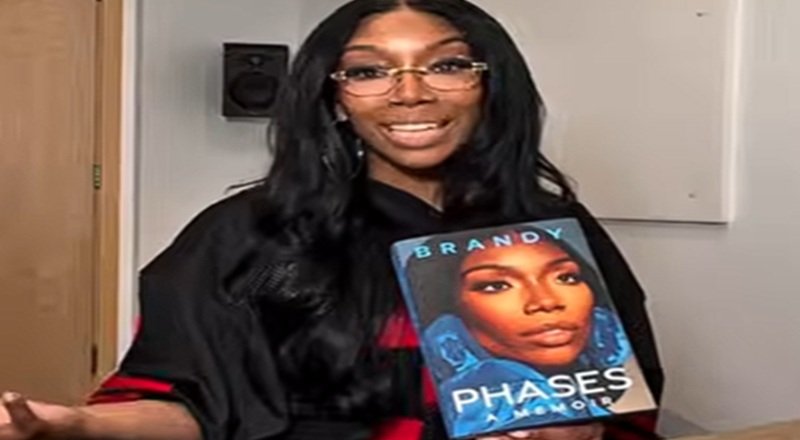
With her debut memoir, Brandy centers authorship, legacy, and Black-owned literary spaces, shaping a release that reflects both personal evolution and cultural intention.
A story that has lived in the public eye for decades rarely belongs entirely to the person who lived it.
For Brandy, visibility arrived early — shaped by music, television, and a cultural presence that positioned her as both voice and symbol. Over time, that visibility expanded into something more complex, where moments of triumph and periods of quiet struggle existed side by side, often interpreted through lenses she did not control. With Phases, her debut memoir, the narrative returns to its origin.
This time, it is written with intention.
Set for release on March 31, 2026, Phases reflects a life shaped not only by success, but by movement — through identity, pressure, growth, and reinvention. Co-written with Gerrick Kennedy, the memoir promises a portrait that moves beyond surface recognition, tracing the interior experiences that accompanied a career spanning more than two decades.
Even before its release, the way the book is being introduced offers insight into its purpose.
A Memoir Rooted in Place and Purpose
Rather than centering the rollout exclusively through traditional retail channels, Brandy has chosen to anchor preorders within six Black-owned independent bookstores. The decision shifts the focus from scale to significance, placing the memoir within spaces that have long held cultural weight far beyond their physical footprint.
Black-owned bookstores have historically functioned as more than sites of commerce. They serve as literary sanctuaries, places where stories are preserved, contextualized, and shared across generations. They exist as archives of thought and identity, where narratives are not only sold but sustained.
Positioning Phases within these spaces creates a framework that aligns the personal with the communal. The memoir becomes part of a broader continuum — one where Black storytelling is supported not just by readers, but by the institutions that protect and uplift it.
Nostalgia as Reinterpretation
Accompanying the preorder campaign is a limited-edition enamel pin inspired by the artwork from Brandy’s 1994 self-titled debut album, reimagined in the deep blue tone of the memoir’s cover. The object, small in scale, carries layered meaning.
The original album marked a moment when a teenage Brandy emerged into public consciousness, offering a voice that felt both grounded and expansive. It introduced an image that would become instantly recognizable, tied to a particular era in music and cultural memory.
Revisiting that image now, decades later, transforms nostalgia into reinterpretation.
The pin becomes a visual conversation between past and present — not a return to who she was, but an acknowledgment of how that version of herself continues to inform who she has become. It invites reflection without requiring permanence.
The Intimacy of Self-Narration
In the short video accompanying the announcement, Brandy speaks directly to the camera with a tone that feels intentionally unguarded. The setting is simple, the delivery conversational, the energy grounded in warmth rather than performance.
The message centers gratitude — for the support of readers, for the presence of the bookstores, for the opportunity to share this next chapter. Yet beneath that gratitude is something more distinct: authorship.
The transition from being written about to writing for oneself carries its own kind of weight. It requires a willingness to revisit moments that may have been misunderstood, overlooked, or reduced to fragments. It asks for clarity where there was once interpretation.
The result is a voice that feels both familiar and newly defined.
Phases as a Language of Becoming
The title itself suggests a life understood through movement rather than fixed identity. Phases are not endpoints; they are transitions — moments that shape, redirect, and refine.
Within that framing, the memoir becomes less about chronology and more about understanding. It allows space for contradiction, for vulnerability, for the quiet shifts that occur outside of public recognition.
For Black women, this idea carries particular resonance. There is often an expectation of continuity — to remain aligned with an image that feels comfortable to others, to resist change in favor of familiarity. Evolution, especially when it includes complexity, is not always granted the same visibility.
Phases challenges that expectation by centering transformation as both natural and necessary.
Storytelling as Cultural Preservation
By linking her memoir to Black-owned bookstores, Brandy situates her personal narrative within a larger cultural framework. The act of storytelling becomes interconnected with the spaces that hold and distribute those stories.
This alignment underscores a broader truth: stories gain meaning not only through their content, but through the communities that engage with them. A memoir placed within culturally intentional spaces carries a different kind of presence — one that acknowledges history, context, and continuity.
It reinforces the idea that personal narratives are never entirely individual. They exist within shared experience, shaped by collective memory and sustained through communal care.
A Release Defined by Intention
What defines this moment is not scale or spectacle, but clarity. The rollout of Phases reflects a series of deliberate choices — where the book is placed, how it is introduced, what it offers beyond its pages.
Brandy’s approach reframes what it means to share a story publicly. It resists urgency in favor of reflection, visibility in favor of grounding, expansion in favor of alignment.
In doing so, it offers something that extends beyond a single memoir.
It presents authorship as a form of self-possession.
It positions storytelling as a space for both personal truth and cultural connection.
And it affirms that a life, when told with intention, can hold far more than what has ever been seen.






Leave a Reply