

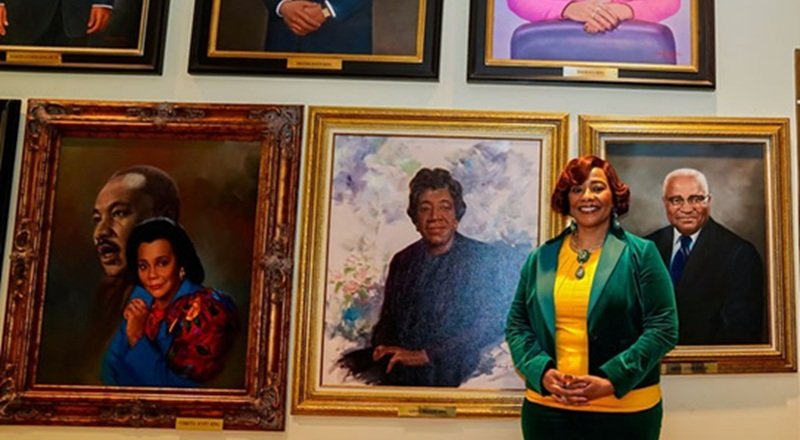
At the Martin Luther King Jr. International Chapel, a family portrait installation becomes a meditation on inheritance, duty, and the quiet weight of carrying history forward.
Inside the Martin Luther King Jr. International Chapel at Morehouse College, legacy is not abstract. It is framed, hung, and witnessed—layered across walls that hold the faces of those who have shaped movements, ministries, and moral imagination.
To stand in that space is to stand in conversation with history.
For Bernice King, that moment became deeply personal. Her recent reflection on the installation of her family’s portraits within the chapel’s Hall of Honor carries a quiet gravity. It is not simply the addition of new images to a revered collection. It is an acknowledgment of proximity—to purpose, to sacrifice, and to the enduring expectations that accompany both.
Her words resist celebration for its own sake. Instead, they return to something more grounded: humility.
Portraits That Speak Beyond the Frame
The visual itself is striking. Bernice stands composed, framed by portraits that have long defined the moral architecture of the space. Nearby, familiar images—her father, her lineage, figures whose lives were shaped by conviction—form a silent yet commanding backdrop.
But the installation is not presented as a personal milestone in isolation.
“These are not just images on a wall,” she writes. The distinction matters. Portraits, in this context, are not decorative. They are narrative; They hold memory, discipline, and consequence; They are reminders of lives that did not simply exist but were committed—often at great cost—to something larger than themselves.
To be placed among them is not only an honor. It is an alignment.
Family as Witness, Not Just Presence
What deepens the moment is not only the setting, but the gathering itself. Twenty-one members of the King family stood together in that chapel, spanning generations. The images shared reflect something rarely captured in public discourse about legacy: its intimacy.
There is joy in the photographs—smiles exchanged, bodies leaning toward one another, a sense of shared recognition. Yet there is also a visible awareness of what the moment represents. Not performance, but presence.
Family, in this instance, becomes witness.
The collective nature of the experience reframes legacy as something communal rather than individual. It is not carried by one name alone, but distributed across relationships, responsibilities, and lived choices. The gathering underscores that history, when inherited, does not remain static. It moves through people.
Recognition and the Weight That Follows
Bernice King’s language returns repeatedly to responsibility. It is a deliberate shift away from the language of achievement.
“We stood not only in recognition, but in responsibility.”
That distinction anchors the entire moment. Recognition, while meaningful, is finite. It marks a point in time. Responsibility, by contrast, extends forward. It requires action, intention, and continuity.
In spaces like the Morehouse chapel—where the concept of the “Beloved Community” is not theoretical but foundational—this framing feels especially resonant. Legacy is not preserved through admiration alone. It is sustained through practice.
The installation, then, becomes less about arrival and more about continuation.
Morehouse as Living Archive
The Martin Luther King Jr. International Chapel has long functioned as more than a memorial. It is a living archive—one that does not simply honor the past, but insists on its relevance.
The Hall of Honor, with its hundreds of portraits, reflects a global lineage of individuals committed to justice, faith, and service. The inclusion of the King family within this space reinforces an existing connection, while also expanding it.
Morehouse itself, as Dr. King’s alma mater, holds a particular symbolic weight. It is both a site of formation and a site of return. For Bernice King, standing there is not new—but this moment reframes that relationship. It situates her not only as a descendant, but as a participant in an ongoing narrative.
The space does not allow for passive remembrance. It invites engagement.
Legacy as Practice, Not Inheritance
Perhaps the most striking element of Bernice King’s reflection is her rejection of legacy as something static.
“Legacy is not something we inherit and admire. It is something we must live, carry, and extend.”
The statement is both simple and exacting. It removes the comfort often associated with legacy—the idea that proximity to greatness is, in itself, enough. Instead, it redefines legacy as an active process. One that requires alignment between belief and behavior.
This perspective resonates beyond the moment itself. It speaks to a broader cultural understanding of inheritance—particularly within communities where history is both deeply honored and continually contested.
To carry legacy, in this sense, is to remain accountable to it.
The Quiet Power of Continuation
There is no spectacle in this moment. No grand performance, no overt declaration. And yet, its impact is undeniable.
A portrait on a wall. A family gathered in shared recognition. A reflection that resists sentimentality in favor of clarity.
Together, they form something more enduring than a ceremony.
They offer a vision of legacy that is not confined to the past, but actively unfolding in the present. One that is not defined by proximity to history, but by the willingness to engage with it fully.
In that chapel, surrounded by those who came before, Bernice King does not position herself as separate from the work. She situates herself within it.
And in doing so, she reminds us—quietly, but unmistakably—that legacy is never finished.











Leave a Reply