

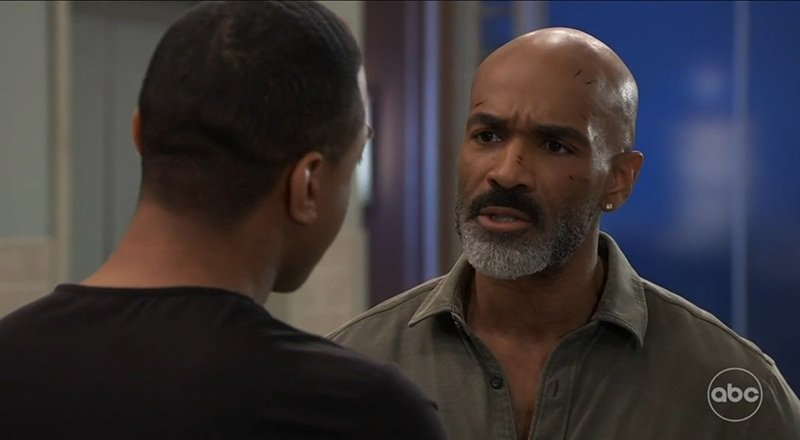
As Jordan confronts recovery and identity, Curtis, Portia, and Isaiah find themselves entangled in a delicate balance of care, control, and unspoken truths.
Recovery, particularly when it alters the visible self, has a way of shifting more than the body. On the April 22 episode of General Hospital, Jordan’s (Tanisha Harper) healing journey became the emotional center of a storyline that moved with restraint, allowing vulnerability—not spectacle—to carry the weight.
Around her, three figures—Curtis, Portia, and Isaiah (Donnell Turner, Brook Kerr, Sawandi Wilson)—circled in varying degrees of devotion, tension, and quiet calculation. What unfolded was less about immediate resolution and more about the subtle reordering of relationships under pressure.
Jordan Confronts the Mirror—And What It Reflects
Jordan’s recovery is no longer confined to medical charts or clinical updates. It has become deeply personal, tethered to identity, perception, and the quiet fear of becoming unfamiliar to oneself.
In a candid moment at the café, she allowed Curtis (Donnell Turner) to see the fullness of that fear. The physical injuries, while serious, were only part of the story. What lingered beneath was a question far more intimate: what happens when the version of oneself that once felt certain begins to shift?
Her concerns about multiple surgeries and the uncertainty of her appearance were expressed without dramatics, making them all the more striking. She did not posture. She did not minimize. She simply told the truth.
And within that truth sat a vulnerability that rarely receives space—especially for women accustomed to composure.
Curtis as Anchor—Steady, but Not Without Edges
Curtis positioned himself as a constant, offering reassurance that felt both sincere and deliberate. His insistence that his feelings would remain unchanged carried weight, but also revealed something quieter beneath the surface: a need to stabilize what he fears could unravel.
His presence beside Jordan reads as protective, but not entirely neutral.
That tension surfaced most clearly in his confrontation with Isaiah Gannon (Sawandi Wilson). What began as concern for Jordan quickly sharpened into territoriality, with Curtis drawing a firm boundary—one that Isaiah refused to accept without challenge.
Curtis’s instinct to control the situation, to define who belongs within Jordan’s orbit, introduces a subtle complication. Support, in this context, edges toward authority.
And Jordan, even in recovery, is not someone easily contained.
Portia’s Diplomacy—Measured, Strategic, Necessary
If Curtis represents emotional certainty, Portia operates within nuance.
Her conversation with Jordan in the hospital waiting room was marked by a kind of honesty that felt intentional rather than spontaneous. She acknowledged their history—one shaped by mutual distrust—without attempting to erase it.
Instead, she reframed the present.
Portia’s encouragement for Jordan to accept help was not framed as pity, but as practicality. Healing, she implied, requires a level of openness that pride alone cannot sustain.
More striking, however, was her broader proposition: coexistence.
Not reconciliation, not forgiveness—just a willingness to exist within the same space without constant friction. The reasoning was clear. Their lives are too intertwined, their families too connected, for continued hostility to remain sustainable.
It was a pragmatic form of grace.
Isaiah Gannon—Composed, Yet Increasingly Central
Isaiah’s role in the episode moved quietly but significantly.
His exchange with Curtis revealed a composure that bordered on detachment. He did not escalate, nor did he retreat. Instead, he redirected, suggesting that Curtis’s anger may have less to do with him than it appears.
That observation, while measured, carried an edge.
Later, in his conversation with Portia, Isaiah’s tone shifted toward something softer—more personal. His empathy for Jordan’s condition felt genuine, yet it existed alongside a desire to maintain closeness with Portia, inviting her into a more private space away from the hospital’s emotional gravity.
The balance he maintains—between empathy, deflection, and control—makes him increasingly difficult to read.
And within that ambiguity, tension builds.
Suspicion Enters the Frame
The episode’s most pivotal shift arrived not through confrontation, but through information.
Dante’s (Dominic Zamprogna) update to Curtis regarding the accident introduced a new layer to the narrative: physical evidence linking the crash to a black German-made vehicle. A detail that, on its own, might seem procedural—until Curtis made the connection.
Isaiah drives a black SUV.
The realization did not explode outward. It settled. Quiet, deliberate, and unresolved.
Suspicion, once introduced, rarely remains contained. It alters perception, reframes past interactions, and quietly reshapes trust.
Curtis’s resolve to uncover the truth, already sharpened by Jordan’s condition, now carries a more personal edge.
A Storyline Defined by Restraint
What distinguished this episode was not dramatic escalation, but emotional precision.
Each character moved within their own internal logic—Jordan navigating vulnerability, Curtis balancing devotion with control, Portia managing relational diplomacy, and Isaiah maintaining a carefully constructed composure.
No definitive answers emerged. No conflicts reached resolution.
Instead, the episode allowed tension to settle into the spaces between words, gestures, and glances.
And in doing so, it mirrored something deeply familiar: the quiet complexity of relationships under strain, where care and conflict often exist in the same breath.
The story, for now, remains open.
And within that openness lies its power.












Leave a Reply