
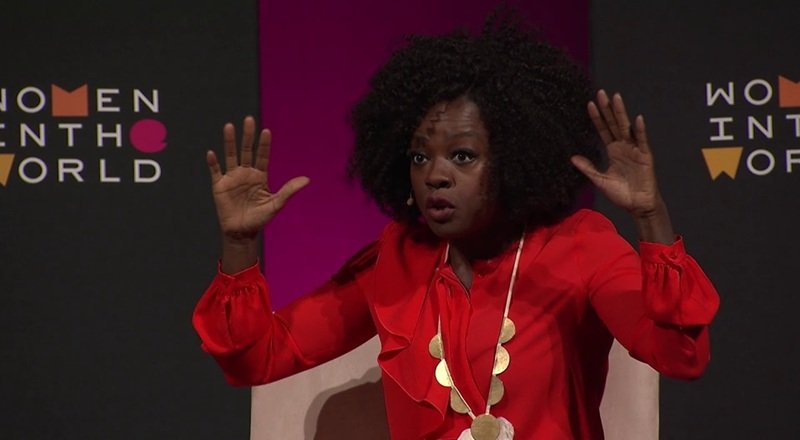
A resurfaced quote from Viola Davis reframes performance as a shared act of trust—one that reflects deeper cultural values around presence, humility, and collective brilliance.
Viola Davis has never treated acting as a performance to be perfected in isolation. For her, it is something far more fluid—an exchange shaped in real time, dependent on presence, trust, and the willingness to be changed by another person. In a resurfaced quote now circulating again, she distills that philosophy into a strikingly direct principle: whatever another actor gives her, she uses.
It is a perspective that feels deceptively simple, but it carries the weight of decades of discipline, craft, and lived experience.
The Art of Letting Go While Staying Prepared
Davis does not reject preparation—she reframes it. The work done at home, she explains, is essential, but incomplete. It builds the foundation, not the final form. By the time she steps onto a set, that preparation must loosen, creating space for something unscripted to take shape.
There is a quiet confidence embedded in that approach. It requires an actor to trust that what emerges in the moment will be enough—that instinct, training, and emotional awareness will meet whatever is offered. For Davis, that trust is not accidental; it is cultivated.
This balance between structure and surrender is what allows her performances to feel so alive. They never appear locked in. Instead, they move, shift, and respond, as though unfolding for the first time.
Presence as Power, Not Perfection
What Davis ultimately challenges is the idea that mastery comes from control. In many creative spaces, control is mistaken for excellence—the tighter the performance, the more “professional” it appears. But Davis dismantles that notion entirely.
Her work suggests that presence is the real measure of power. To be fully present means remaining open, even when something unexpected disrupts what was planned. It means listening with intention rather than waiting to execute.
That distinction transforms performance into something relational rather than individual. It becomes less about delivering a perfect line and more about discovering it in conversation with someone else.
A Philosophy Rooted in Black Creative Tradition
Davis’s approach does not exist in a vacuum. It echoes a broader cultural lineage where improvisation, responsiveness, and shared energy are central to artistic expression. Across Black creative traditions—from jazz to oral storytelling—the most powerful moments are rarely rigid. They are shaped through interaction.
That same principle is visible in Davis’s work. Her insistence on “saying yes” to a scene partner reflects a deeper understanding of collaboration as a form of cultural language. It honors the idea that creativity expands when it is allowed to move between people, rather than being contained within one vision.
For Black women, this perspective carries additional resonance. It challenges the expectation to be controlled, composed, and unyielding at all times, offering instead a vision of strength rooted in adaptability.
Annalise Keating and the Practice of Responsiveness
Few roles illustrate this philosophy more clearly than Annalise Keating. Throughout How to Get Away with Murder, Davis’s performance was defined by its unpredictability—moments that felt reactive, immediate, and emotionally layered.
Her courtroom scenes, in particular, carried a sense of volatility. A line could shift in tone mid-delivery, a pause could hold unexpected weight, a glance could redirect the entire scene. That fluidity is exactly what Davis describes: the ability to meet a moment as it happens, rather than forcing it into a predetermined structure.
The image of her as Annalise—mid-gesture, commanding the room—captures that dynamic energy. It is not just authority being performed; it is authority being negotiated in real time.
Collaboration as a Form of Trust
At the core of Davis’s message is a deeper principle: collaboration requires trust. To truly “use” what another actor gives means relinquishing a certain level of control. It means accepting that the best version of a scene may not be the one imagined in advance.
That kind of openness can feel risky. It demands vulnerability, a willingness to be influenced, even disrupted. But Davis reframes that vulnerability as strength. It is what allows something authentic to emerge.
Her critique of actors who attempt to control their scene partners speaks directly to this. When one person tries to dictate the outcome, the exchange collapses. The work becomes rigid, disconnected from the spontaneity that gives it life.
Beyond Acting: A Blueprint for Engagement
While Davis speaks from the perspective of an actress, her insight extends far beyond the set. The idea of meeting people where they are—of responding rather than imposing—has relevance across creative and professional spaces.
It suggests a model of engagement rooted in listening. One that values adaptability over dominance, curiosity over certainty. In a culture that often rewards control, this approach offers a quieter, more enduring form of influence.
To “use what is given” becomes not just an acting technique, but a way of navigating relationships and environments with intention.
The Enduring Power of Staying Open
That this quote continues to resurface speaks to its clarity. It cuts through performance in the most literal sense, reminding us that authenticity cannot be constructed in isolation. It must be built in collaboration, shaped by presence, and sustained through trust.
Viola Davis’s career stands as proof of that philosophy. Her performances resonate not because they are tightly controlled, but because they feel lived-in, responsive, and real.
In a world that often equates strength with certainty, her approach offers something more expansive. A reminder that power can also look like openness. That mastery is not about having all the answers, but about being ready—fully and honestly—for whatever arrives.






Leave a Reply