

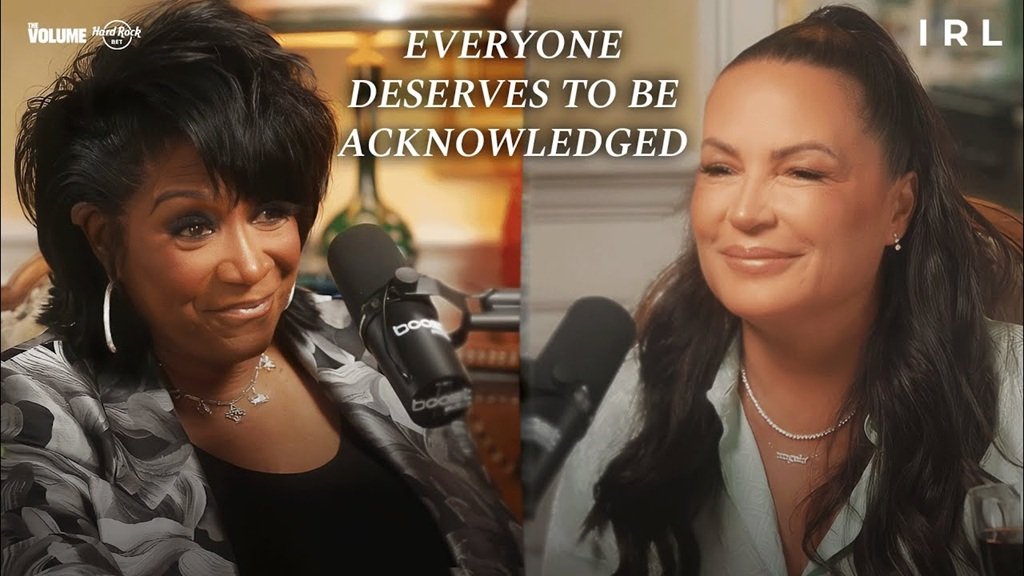
A conversation that moves beyond music into purpose, presence, and the quiet power of enduring joy.
Patti LaBelle has always been more than a voice.
To reduce her to her catalog—even one filled with classics like “On My Own” and “Somebody Loves You Baby”—would be to miss the deeper truth of her presence. What unfolds in her conversation with Angie Martinez is not simply a reflection on music, but a meditation on life lived fully, imperfectly, and with remarkable intention.
There is a softness to Patti that contrasts beautifully with her powerhouse reputation. Between laughter, storytelling, and moments of stillness, she reveals something far more enduring than performance: perspective.
And that, more than anything, is what lingers.
The Meaning Behind the Music
When Patti revisits her classics, she does so without romanticizing them.
Songs like “On My Own,” released decades ago, still resonate because of their emotional honesty. The narrative of separation, of finding oneself after love shifts or ends, remains timeless. Patti acknowledges this plainly—sometimes, relationships change, and both people must continue forward, separately yet peacefully.
“I’m on my own… but I’m doing well. And so is he,” she reflects.
It’s a perspective that feels quietly radical. There is no bitterness in her framing, only acceptance. A recognition that love does not always need to end in fracture to be meaningful.
Even in “Somebody Loves You Baby,” a song rooted in deep devotion, Patti draws a boundary between performance and personal truth. Lyrics may suggest surrender, but her interpretation remains grounded in self-possession.
She sings the feeling—but she never loses herself inside it.
Love, Independence, and Emotional Clarity
What emerges throughout the conversation is a woman who understands love without being defined by it.
Patti speaks candidly about marriage, divorce, and the evolution of connection. A 35-year partnership came to an end, not through chaos, but through clarity. The decision, she explains, was mutual and necessary.
“We knew we had to split,” she says, without dramatics.
What follows is perhaps even more striking—the continuation of respect. Friendship remains. Family remains. The relationship simply changes form.
In a cultural moment that often frames endings as failures, Patti’s perspective feels expansive. Love, in her world, is not diminished by transformation. It is redefined by it.
The Quiet Confidence of Aging
At 80, Patti LaBelle does not speak about aging with hesitation.
Instead, she approaches it with a kind of ease that feels both rare and instructive. There is no urgency to reinvent herself, no anxiety about relevance. She exists fully in who she is—past, present, and still becoming.
“I’ve been whoever I am now that I was at 20,” she shares.
That consistency is not stagnation—it’s alignment. A deep understanding of self that has only sharpened over time.
She continues to tour. Continues to record. Continues to imagine new projects, including a long-awaited return to R&B. Not out of pressure, but desire.
Longevity, in her case, is not about maintaining youth. It’s about sustaining purpose.
Business, Legacy, and Reinvention
Patti’s transition into entrepreneurship feels less like a pivot and more like an extension of who she has always been.
Cooking, something she loved long before it became a business, evolved naturally into a thriving food brand. What began with sweet potato pies has expanded into a broader culinary empire—breakfast foods, pantry staples, and more.
Her approach is simple: quality, authenticity, and pride in the product.
“When you give great food for a decent price, you feel great about your product,” she explains.
There is also something deeply intentional about building this business alongside her son. Trust, she notes, is foundational. It’s not just about success—it’s about alignment, shared vision, and generational continuity.
Legacy, for Patti, is not abstract. It is tangible. Built. Shared.
Joy as a Daily Practice
Perhaps the most striking aspect of Patti’s presence is her relationship to joy.
It is not presented as something constant or effortless. She acknowledges the weight of the world—the uncertainty, the heaviness, the things that cannot be ignored. And yet, she chooses joy anyway.
Not through grand gestures, but through everyday rituals.
Cooking. Playing cards. Spending time at home. Laughing with friends.
“I’m happy being home,” she says, simply.
There is elegance in that simplicity. A reminder that joy does not always require reinvention. Sometimes, it lives in the familiar.
Faith, Loss, and Endurance
Beneath the lightness, there is also depth shaped by loss.
Patti speaks openly about losing her sisters at young ages, an experience that inevitably reshaped her understanding of time and gratitude. Surviving where others did not has given her a perspective rooted in appreciation rather than assumption.
“I’m still standing… and it is because of God,” she shares.
Faith, for her, is not performative. It is internal. Personal. A quiet dialogue that informs how she moves through the world.
Even in grief, she finds connection—continuing to speak to those she has lost, carrying their presence with her in both memory and spirit.
It is this balance—between loss and gratitude—that gives her outlook its depth.
A Life Lived Without Apology
If there is a single thread that defines Patti LaBelle’s story, it is this: she does not apologize for who she is.
Not for her voice. Not for her generosity. Not for her refusal to harden, even when life has given her reason to.
She describes herself as someone who gives—sometimes to a fault—but makes no effort to change that part of her nature. It is, in her words, simply who she is.
And perhaps that is the most powerful takeaway.
Because in a world that often encourages constant self-editing, Patti offers something different. A model of self-acceptance that is neither passive nor performative, but deeply rooted in truth.
A life lived fully. Openly. And without apology.









Leave a Reply