

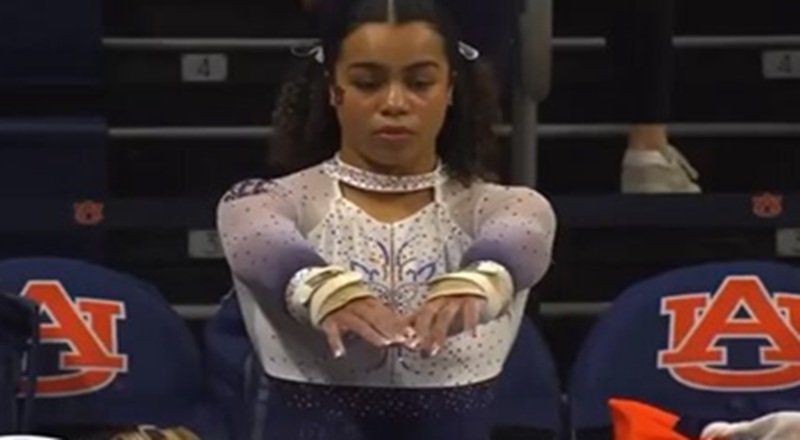
Auburn’s rising star delivers more than a record-setting vault — she offers a moment of clarity about power, lineage, and what it means for young Black gymnasts to see themselves reflected at the highest levels.
Some athletic moments arrive with a kind of quiet inevitability — the sense that a young woman has been training not just for a skill, but for a shift. Sophia Bell’s Yurchenko double full, landed cleanly and crowned with a 9.925, felt like one of those moments. A vault defined by risk, precision, and rarefied difficulty suddenly became something more intimate: a declaration of belonging in a space where Black women’s presence is still far too uncommon.
Bell sprinted down the runway with the velocity of someone who has studied not only technique, but how to trust her own momentum. The round-off, the back handspring, the two full twists — all executed with the kind of authority that makes an arena lean forward — told the story of an athlete fluent in her discipline. But the expression she carried after her feet struck the mat, still and sure, revealed the larger truth of the day. Her joy wasn’t triumph alone; it was recognition. This vault, once reserved for the upper edges of elite competition and rarely attempted in the NCAA, had found a new steward.
And she had stuck it.
The Anatomy of a Breakthrough
A Yurchenko double full demands audacity. It asks for height, speed, and absolute clarity in the air — the kind of clarity that leaves no space for hesitation. The vault’s rarity in collegiate gymnastics isn’t a lack of ambition; it’s physics, injury risk, and the quiet negotiations athletes make between pushing boundaries and preserving longevity.
Yet in the years since Simone Biles expanded the vocabulary of women’s vaulting, something subtle has shifted. Skills once imagined as outliers now carry an invitation. Bell’s execution felt like an acknowledgement of that evolution — grounded, studied, and delivered with a softness in her landing that belied the vault’s 5.0 difficulty value.
But history isn’t made solely by athleticism. It’s made by context.
A First That Means More
When Auburn announced that no gymnast in program history had ever completed this vault in competition, it was already a milestone. But the deeper resonance came from who delivered it. Bell, the only Black gymnast on Auburn’s roster, has been candid about what representation means to her — how she sees her work as both performance and message, how she wants “little brown gymnasts” to watch her and recognize a possibility that wasn’t always visible.
For many girls, gymnastics still arrives wrapped in exclusivity: the cost, the culture, the quiet expectation of who traditionally fits the sport’s aesthetic and who is rarely centered within it. A young Black woman performing one of the most complex vaults in the NCAA — and performing it flawlessly — becomes a sort of cultural vocabulary. A new sentence in a language that is still expanding.
Her flight wasn’t just height; it was inheritance.
Joy as a Signature
The slow-motion edits circulating online captured every detail — the rise, the rotation, the alignment of form. But it was the replay of Bell’s smile, framed mid-twist, that caught the public imagination. There is something undeniably disarming about a gymnast who can hold delight inside a skill defined by risk. It changes the emotional texture of the moment. Instead of fear, you see freedom. Instead of pressure, you see mastery. Instead of strain, you see a woman unafraid to take up space in the air.
That joy became its own kind of signature — a reminder that power doesn’t have to announce itself through tension. Sometimes it arrives as ease.
The Lineage Behind the Leap
Gymnastics evolves on a continuum. Every upgrade exists because someone before it dared to shift the boundary line. Biles, of course, pushed vaulting into a new era. Before her, countless women — many U.S. gymnasts of color overlooked by mainstream narratives — expanded the sport through innovation, interpretation, or sheer grit. Bell’s moment folds into that generational story.
And at the personal level, her journey from a hyperactive toddler in Missouri to a four-time national qualifier and now an SEC standout is not a tale of sudden emergence but patient refinement. The foundation was laid long before this vault. What changed in January was visibility: the world finally saw the fullness of her intention.
Auburn’s New Center of Gravity
Every team benefits from an athlete willing to shift what is considered possible. Bell’s vault doesn’t just raise Auburn’s scoring ceiling — it alters how her teammates, coaches, and even her competitors imagine the season ahead. Difficulty creates momentum. Momentum creates culture.
And culture is what sustains a program long after the viral clip fades.
The Future Written in the Air
What lingers from Bell’s historic vault is not the physics or the numbers, but the feeling. The sound of a crowd that knew it had witnessed something special. The image of a young woman stepping into a legacy that extends beyond medals or rankings. The knowledge that somewhere, a little girl is watching the replay on her phone, noticing that the athlete in the white Auburn leo looks like her — and realizing that complexity, grace, and flight belong to her too.
Sophia Bell didn’t just complete a vault.
She carved a pathway in the air.
And she made it look like joy.











Leave a Reply