
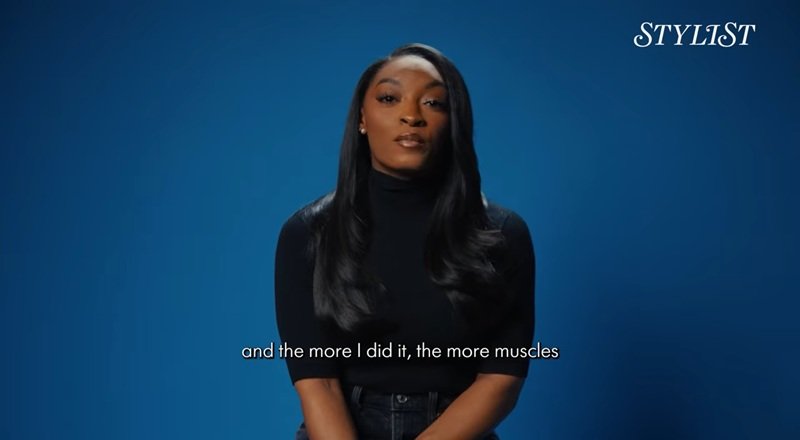
On her International Women’s Day cover, Simone Biles offers something more enduring than achievement — a redefinition of worth rooted in mental health, self-trust, and quiet sovereignty.
Simone Biles has spent most of her life being asked to rise.
Rise higher. Move faster. Deliver more. Stay composed; Stay perfect; Stay winning.
It is a language Black women know well — the constant expectation to exceed, to endure, to carry excellence not as an aspiration but as a requirement. For years, Biles embodied that expectation with a kind of gravity-defying precision, transforming her body into a vessel of history-making moments and her discipline into something nearly mythological.
But what she offers now, in a still portrait for Stylist’s International Women’s Day issue, feels far more radical than any medal.
A sentence.
A boundary.
A truth.
“No medal, accolade, job success or exam result is more important than your mental health.”
It reads simply. It lands deeply.
The Quiet Power of Redefining the Standard
The image itself is striking in its restraint. A black turtleneck. Minimal adornment. A soft, intentional gaze set against a calm blue backdrop. There is no spectacle here — no mid-air twist, no explosive motion. Just presence.
And in that stillness, something shifts.
For a woman whose career has been defined by movement, this moment feels like an act of reclamation. Biles is no longer performing for the world’s expectations; she is speaking directly to it. More importantly, she is speaking to the next generation of girls — and to the women who are still unlearning the belief that their worth is tied to how much they can withstand.
What It Means to Choose Yourself in Public
When Biles stepped back during the Tokyo Olympics, citing the disorienting mental block known as the “twisties,” the response was immediate and divided. Some saw it as vulnerability. Others misread it as retreat.
But for many Black women, the moment was unmistakable.
It was recognition.
To choose oneself in public — especially in a space that rewards endurance above all else — is rarely framed as strength. It requires a different kind of courage, one that does not seek applause but demands alignment. Biles chose clarity over performance. Safety over expectation. Self-trust over spectacle.
And in doing so, she disrupted a narrative that has long followed Black women: that strength must always be visible, unbreakable, and unquestioned.
The Lesson Beneath the Legacy
Her career, by any metric, is already unparalleled. Eleven Olympic medals. Thirty World Championship titles. A body of work that has redefined what is physically possible in gymnastics.
But this moment reframes her legacy in a quieter, more expansive way.
Because what she offers now is not just inspiration — it is instruction.
The “lesson that matters,” as framed by Stylist, is not about how to win. It is about how to remain whole. It is about understanding that achievement without alignment comes at a cost, and that the cost is often carried internally, long after the applause fades.
For Black women, this message resonates with particular clarity. The pressure to excel — academically, professionally, culturally — is often accompanied by the expectation to do so without complaint, without pause, without visible strain. Rest becomes negotiable. Softness becomes conditional. Mental health becomes secondary.
Biles refuses that hierarchy.
A New Language for Success
What emerges from her story is a redefinition of success that feels both deeply personal and culturally expansive.
Success, in this framing, is not accumulation. It is awareness;
It is the ability to recognize when something no longer serves you — even when the world insists that it should;
It is the decision to step away without diminishing your worth;
It is choosing a life that feels sustainable, not just impressive.
This language feels especially necessary now, as conversations around burnout, wellness, and emotional resilience continue to surface across industries. Yet Biles brings a specificity to it — one shaped by the lived experience of being a Black woman in spaces where perfection is often expected and humanity is rarely prioritized.
The Power of What She Teaches Without Performing
What makes this moment linger is not its scale, but its intimacy.
A woman who has spent her life at the center of global attention choosing to speak about something deeply internal. A shift from external validation to internal grounding. A message that does not require spectacle to be understood.
In many ways, this is the evolution of her influence.
She is no longer just showing what the body can do;
She is showing what the mind must protect;
She is reminding women — especially Black women — that they are allowed to choose themselves before they are forced to.
A Lesson That Extends Beyond the Cover
The reach of Stylist’s “Lessons That Matter” campaign extends into classrooms, public spaces, and conversations across generations. But Biles’ contribution feels particularly enduring because it addresses something foundational: the right to exist without constant performance.
It is a lesson many women learn late. Some are never taught it at all.
And yet here it is, offered plainly.
Mental health is not a reward.
It is not something to be earned after exhaustion;
It is not secondary to achievement;
It is the foundation.
What Remains
Simone Biles will always be remembered for what she accomplished in the air. The height, the rotation, the precision — the moments that felt almost beyond human.
But this chapter of her story asks something different of us.
To look at her not just as an athlete, but as a woman who chose to redefine what success looks like in real time. To understand that the most powerful decision she made may not have been a routine, but a refusal.
And to carry forward the lesson she now offers with clarity:
Nothing — not recognition, not expectation, not even greatness — is worth the cost of losing yourself.











Leave a Reply